Become the master of the embers! In this article, we’ll show you all aspects of regulating the heat on your charcoal barbecue including fuel types, required temperatures, and direct and indirect barbecue cooking.
How to control the temperature of your charcoal barbecue
How to control the temperature of a charcoal barbecue
Learning how to control the temperature of your charcoal barbecue opens up more ways to cook. You can sear steaks over intense direct heat, roast a whole chicken more gently or hold a steady low temperature for tender pulled pork.
The basic principle is simple: charcoal needs oxygen to burn. The more air that reaches the coals, the hotter they burn. Once the temperature is under control, you can spend less time watching the coals and more time enjoying the food and company around you.
In this guide, we’ll explain how to choose and measure your fuel, manage the vents and set up direct or indirect heat. You’ll also learn how to raise, lower and maintain the temperature throughout your cook.
- The three keys to controlling charcoal barbecue temperature
- Choose the right charcoal for the way you want to cook
- Start with the right amount of charcoal
- Preheat the barbecue before cooking
- How to use the vents on a charcoal barbecue
- Use the lid to keep the temperature steady
- Choose between direct and indirect heat
- How to adjust barbecue temperature
- Frequently asked questions
- Bring the heat under control
The three keys to controlling charcoal barbecue temperature
Three factors have the greatest effect on the temperature inside your barbecue:
- The amount of fuel: More lit charcoal creates more heat.
- The airflow: Open vents allow more oxygen to reach the charcoal, increasing the heat. Closing the vents reduces it.
- The position of the lid: Cooking with the lid closed retains heat and creates a steady circulation of hot air around the food.
Weather conditions can also make a difference. Cold temperatures and strong winds may increase fuel use or cause the temperature to fluctuate, so place your barbecue in a sheltered outdoor position where it is safe to do so.
Quick Tip:
To make a charcoal barbecue hotter, open the vents and allow more oxygen to reach the coals. To lower the temperature, partially close the vents. Make small adjustments and allow several minutes for the temperature to settle.
Choose the right charcoal for the way you want to cook
Your choice of fuel affects how quickly the barbecue heats up and how long it can maintain its temperature.
Briquettes for consistent, long-lasting heat
Weber Briquettes are a reliable choice when you want steady heat over a longer period. They are ready to use in approximately 20 minutes and can burn for up to three hours, making them particularly suitable for roasting, smoking and other longer cooks.Their uniform shape also makes it easier to measure a consistent quantity each time you cook.
Lumpwood charcoal for fast, intense heat
Weber Premium Lumpwood lights quickly and burns at a high temperature. It is well suited to searing steaks, grilling burgers or cooking other food that benefits from strong direct heat.
Because the pieces vary in size, lumpwood charcoal can burn less evenly than briquettes and may require closer temperature monitoring during a longer cook.
Start with the right amount of charcoal
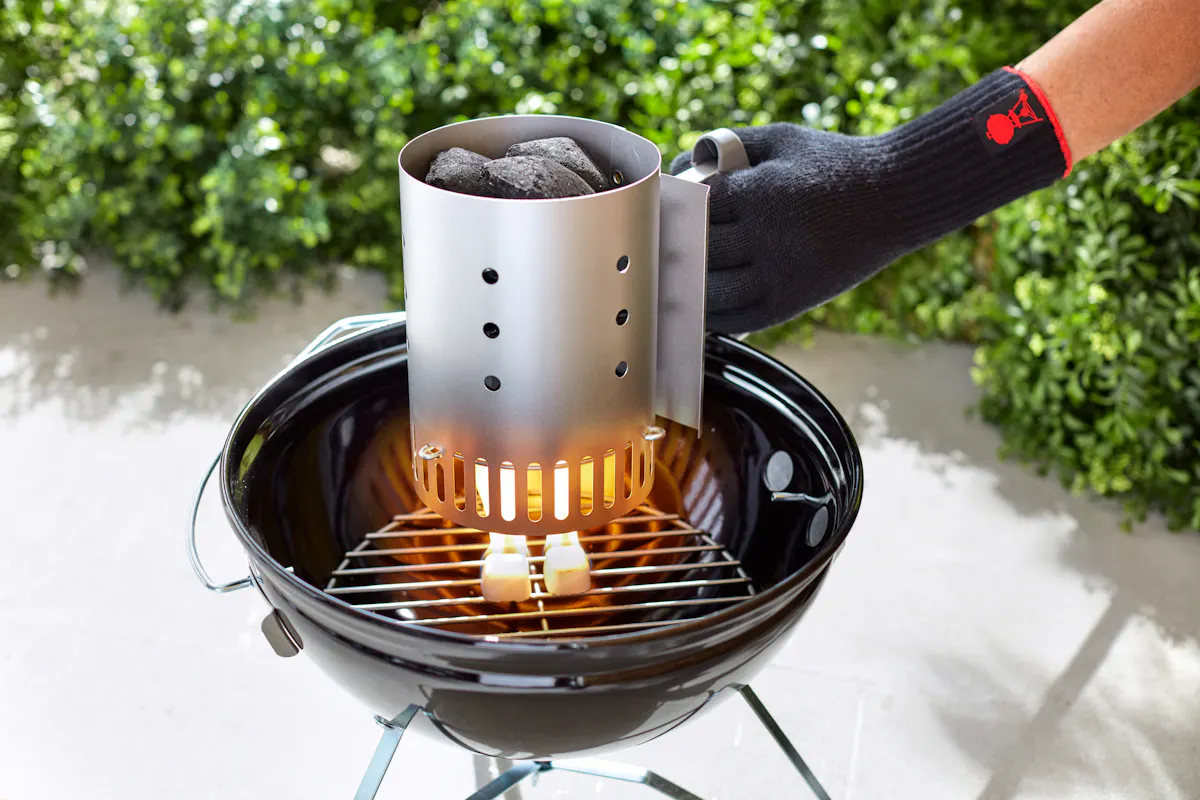
It is easier to control the temperature when you begin with an appropriate amount of fuel. A Rapidfire Chimney Starter helps light the charcoal evenly and can also be used as a simple measuring guide.
As a starting point:
- One-third of a chimney: Low-temperature or shorter indirect cooking
- Half a chimney: Medium-temperature indirect cooking
- A full chimneyHigh-temperature direct cooking
These quantities are a guide rather than a fixed rule. The size of your barbecue, the weather and the length of the cook will all affect how much fuel you need.
How to light charcoal with a chimney starter
- Open the lid and bowl vents.
- Place two or three lighter cubes on the charcoal grate and light them.
- Fill the chimney starter with the required amount of charcoal.
- Position the chimney starter over the lit cubes.
- Wait until the upper coals begin to develop a light grey coating of ash.
- Wearing heat-resistant barbecue gloves, carefully pour the charcoal onto the charcoal grate.
Arrange the lit charcoal for your chosen cooking method, replace the cooking grate and close the lid.
Read our guide to using a charcoal chimney starter to learn how to light your charcoal quickly, evenly and safely.
Safety Note:
Only light and use a charcoal barbecue outdoors. Never use petrol, spirits or a comparable fluid to light or relight charcoal. Follow the instructions supplied with your barbecue, fuel and chimney starter.
Preheat the barbecue before cooking
Preheat your charcoal barbecue with the lid closed for approximately 10–15 minutes. This gives the barbecue time to reach a stable temperature and heats the cooking grate ready for searing.
Keep the vents open during preheating so that the charcoal receives plenty of oxygen. Once the barbecue has reached the required temperature, adjust the vents gradually to maintain it.
If your barbecue has a lid thermometer, use this as a guide to the temperature beneath the lid. For greater accuracy during low-and-slow cooking, position an ambient temperature probe close to the food, without allowing it to touch the cooking grate. Explore Weber’s range of barbecue thermometers and smart grilling tools.
How to use the vents on a charcoal barbecue
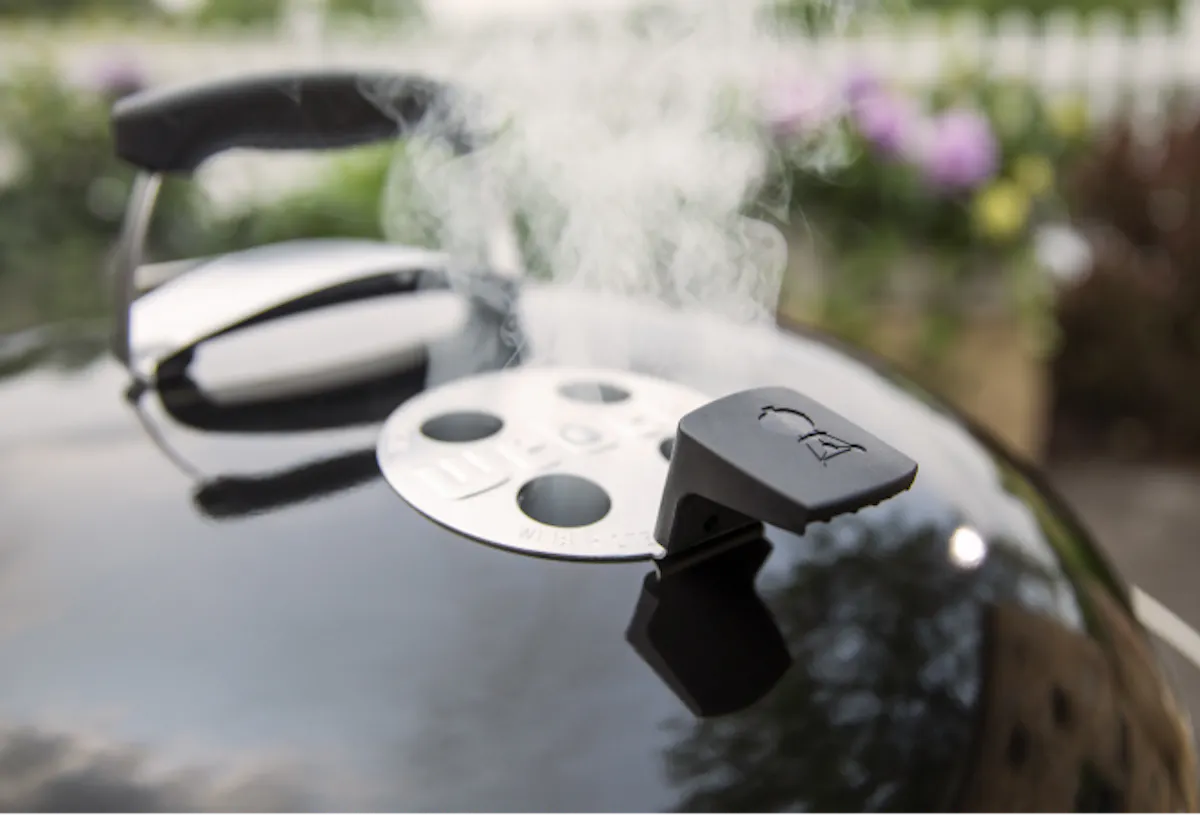
Most Weber charcoal barbecues have two sets of vents:
- The bowl vent controls how much air enters beneath the charcoal.
- The lid vent allows hot air and smoke to leave the barbecue.
Opening the vents increases airflow and helps the charcoal burn hotter. Closing them restricts oxygen and lowers the temperature.
Start with both vents fully open. Once the barbecue approaches your target temperature, partially close a vent to slow the rise. Make one small adjustment at a time, then wait around five minutes before checking the temperature again. Charcoal responds gradually, so frequent large changes can make the heat more difficult to control.
For a simple approach, leave the bowl vent open and use the lid vent for most temperature adjustments. As you gain experience, you can make smaller changes to both vents when you need more precise control.
Do not completely close both vents while cooking. This can extinguish the charcoal.
Suggested vent settings and cooking temperatures
The following settings provide a useful starting point. Exact temperatures will vary according to the barbecue, fuel, weather and quantity of food.
| Heat level | Barbecue temperature | Approximate lid vent position | Suitable for |
|---|---|---|---|
| High heat | 230–290°C | Fully open | Pizza, searing and potatoes |
| Medium heat | 175–230°C | Around half open | Poultry, vegetables and baking |
| Low heat | 120–175°C | Around one-quarter open | Fish, sausages and gentle roasting |
| Low and slow | 95–150°C | Around one-eighth to one-quarter open | Ribs, brisket and pulled pork |
Remember: The barbecue temperature and the food’s internal temperature are different measurements. Use the barbecue thermometer to manage the cooking environment and a food probe to check when meat is safely cooked.
Use the lid to keep the temperature steady
Keeping the lid closed helps the barbecue retain heat and creates convection around the food. It also reduces sudden changes caused by wind and limits the extra oxygen that reaches the charcoal.
Every time you lift the lid, heat escapes and more oxygen reaches the coals. This can extend the cooking time and make the temperature rise or fall unexpectedly.
Check the food only when necessary. For longer cooks, use a connected thermometer or probe so you can monitor progress without repeatedly opening the barbecue.
Position the lid so that its vent sits on the opposite side from the lit charcoal during indirect cooking. This draws heat and smoke across the food before they leave the barbecue.
Choose between direct and indirect heat
How you arrange the charcoal is just as important as the temperature. With direct heat, the food sits above the fuel for quick cooking and high-heat searing. With indirect heat, the fuel sits away from the food, allowing heat to circulate around it for slower, gentler cooking.
Direct heat
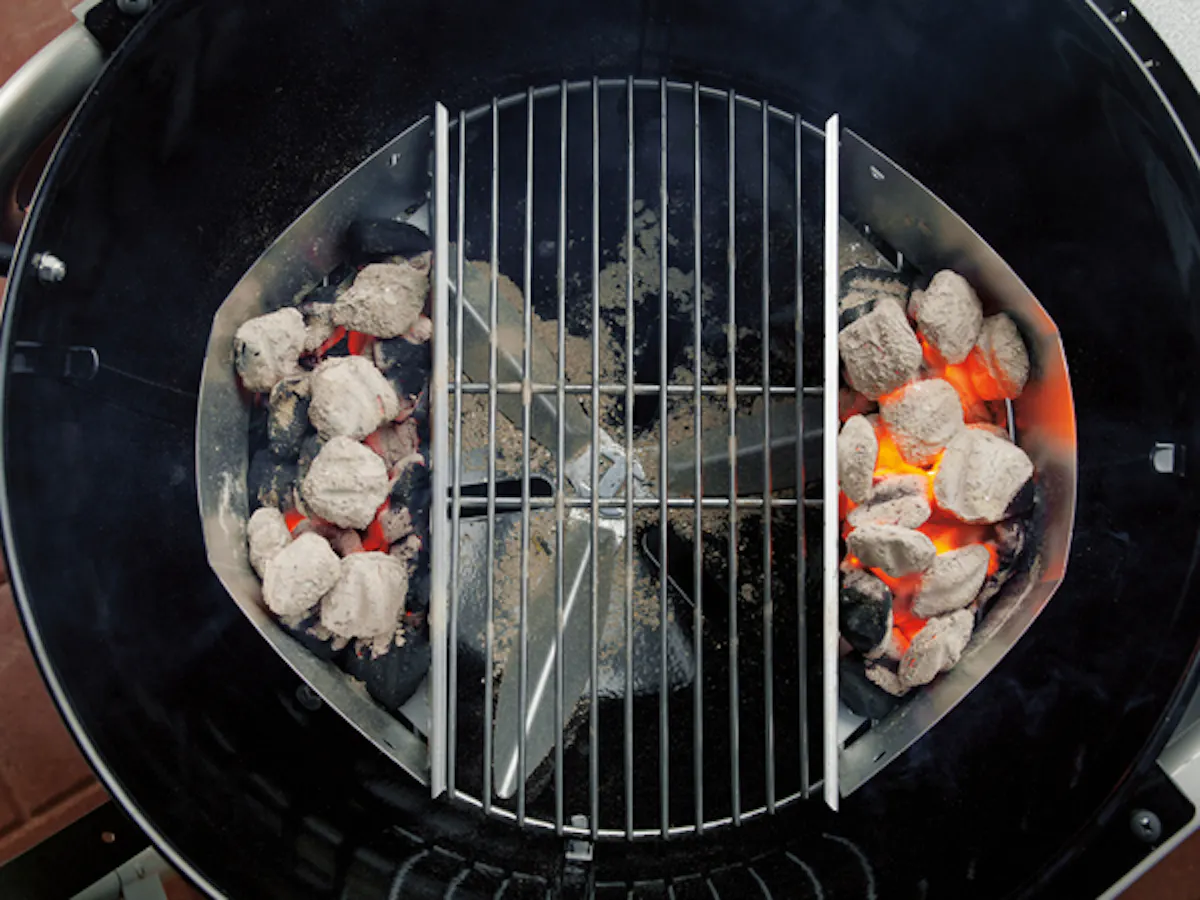
Direct cooking places the food above the lit charcoal. It is best for food that cooks in around 20 minutes or less, including:
- Steaks
- Burgers
- Chops
- Sausages
- Smaller vegetables
Spread the charcoal evenly across the required section of the charcoal grate. Cook with the lid closed where possible, turning the food as needed.
Direct heat produces a strong sear and the sizzling, caramelised surface that makes charcoal cooking so distinctive.
Indirect heat
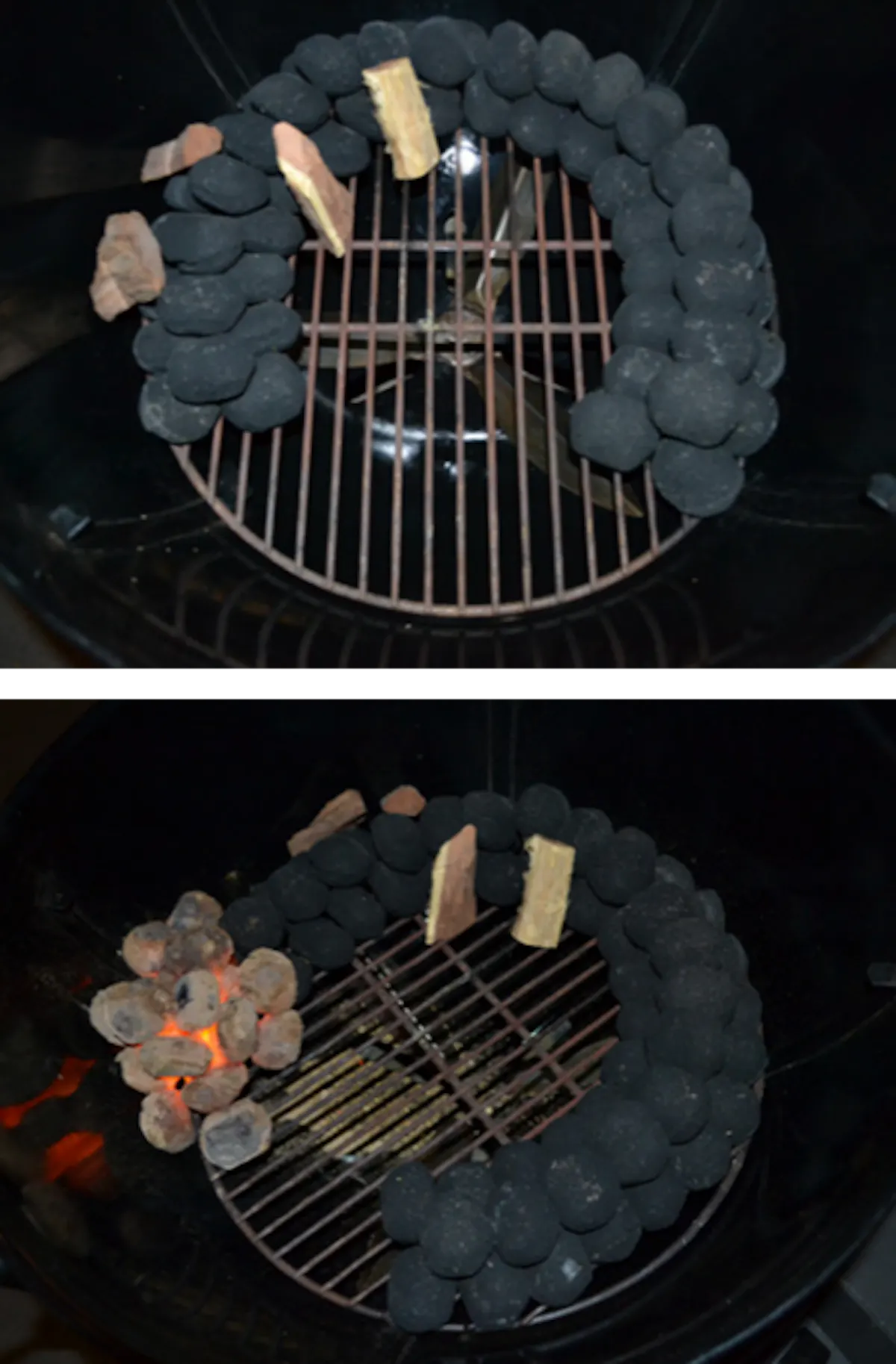
Indirect cooking places the charcoal away from the food, allowing the heat to circulate around it like an outdoor oven. It is ideal for:
- Whole poultry
- Larger joints of meat
- Ribs and brisket
- Bread and cakes
- Food that needs more than 20 minutes to cook
Arrange the charcoal on one or both sides of the barbecue and place the food over the area without coals underneath. A drip pan positioned below the food catches juices and helps keep the barbecue clean.
For a full introduction to both setups, explore our guide to Weber barbecue cooking methods.
Two-zone cooking
A two-zone setup gives you more flexibility, helping you cook different foods at their best and serve everything together. Place the lit charcoal on one side of the grate, leaving the other side clear.
You can sear food over the charcoal before moving it to the cooler side to finish cooking. If food starts to colour too quickly, the indirect zone also gives you somewhere to move it without removing it from the barbecue.
How to adjust barbecue temperature
Even with the right setup, the temperature can change as the charcoal burns, food is added or weather conditions shift. Use the steps below to raise, lower or maintain the heat throughout your cook.
How to increase the temperature
If your charcoal barbecue is not hot enough:
- Open the vents further. Check that ash or debris is not blocking the bowl vent.
- Close the lid. This retains heat while maintaining controlled airflow.
- Check the fuel. Damp or old charcoal can be slow to light and may struggle to reach a high temperature.
- Remove excess ash. A build-up beneath the charcoal can restrict the flow of oxygen.
- Add more lit charcoal if needed. Light it separately in a chimney starter before carefully adding it to the barbecue.
Avoid adding unlit charcoal directly to food that is nearly ready, as this can temporarily lower the temperature and produce extra smoke while the new fuel ignites.
How to lower the temperature
If the barbecue is too hot:
- Partially close the lid vent to reduce airflow.
- Wait several minutes for the temperature to respond.
- Close the bowl vent slightly if the temperature remains too high.
- Move the food to an indirect zone to protect it from intense heat.
- Avoid lifting the lid repeatedly, as the incoming oxygen can make the charcoal burn more strongly.
Do not pour water onto the charcoal to control the heat. This can create hot steam, spread ash over the food and damage the barbecue’s enamel finish.
How to maintain heat during a long cook
For low-and-slow cooking, aim for gradual changes rather than constantly adjusting the vents.
- Use briquettes for a steady, predictable burn.
- Keep the lid closed as much as possible.
- Monitor the barbecue temperature with an ambient probe.
- Check occasionally that ash is not restricting the lower vents.
- Add lit briquettes before the existing charcoal is exhausted.
- Keep fuel dry and ready so it can be added safely when needed.
You can also arrange unlit briquettes in a curved line around the edge of the charcoal grate, then add a small number of lit briquettes at one end. The charcoal will ignite progressively, helping to maintain a low temperature over several hours. Always follow the setup advice for your specific Weber barbecue.
Frequently asked questions
How hot does a charcoal barbecue get?
A charcoal barbecue can reach temperatures above 290°C when filled with lit fuel and operated with the vents open. The achievable temperature depends on the type and amount of charcoal, airflow, barbecue size and weather conditions.
Does opening the vents make a charcoal barbecue hotter?
Yes. Opening the vents allows more oxygen to reach the charcoal, causing it to burn more intensely. Closing the vents reduces the airflow and lowers the temperature.
Should the lid vent be open when cooking?
The lid vent should normally remain at least partially open while cooking. Closing it completely restricts airflow and may extinguish the charcoal. Its position can be adjusted gradually to help control the temperature.
Why does my charcoal barbecue keep losing heat?
Common causes include damp or insufficient fuel, restricted vents, excess ash beneath the charcoal, cold or windy conditions, and opening the lid too frequently. Check each factor before adding more fuel.
How do I extinguish a charcoal barbecue?
When cooking is complete, replace the lid and fully close both the lid and bowl vents. This cuts off the oxygen supply and allows the charcoal to go out. Leave the barbecue closed until the charcoal and ash are completely cold before handling or disposing of them.
Bring the heat under control
Good temperature control begins with the right amount of fuel, open vents and a fully preheated barbecue. From there, make small adjustments, keep the lid closed and give the temperature time to respond.
Once you can hold a steady heat, you can spend less time managing the fire and more time around the table. Whether you are searing food for a quick meal or slow-cooking something to share, a little control helps bring everyone together over food that is worth waiting for.
Our Weber Recipes

Charcoal Barbecuing
How to use a charcoal barbecue
